Multi-player build
Agent work isn’t a solo act. People and agents build together — same session, same context, no matter who’s driving.
Joint sessions
Pair program with a teammate on the same live session — from a laptop, a tablet, your phone, anywhere. No terminal, no screen-share, no waiting for someone to be at their desk.
Learn more about joint sessionsSession handoffs
Pass a session to another teammate or another agent, and the context goes with it. Nothing gets re-explained, nothing gets lost — work picks up exactly where it left off, for any reason, any time.
Learn more about session handoffsSession recall
Your agent learns from the work your team has already done. Past decisions, past fixes, past context surface in your sessions the moment they’re relevant, so your team never solves the same problem twice.
Learn more about session recallCode review
Nothing ships unchecked. Agents review agents, agents review alongside you, or both. However you like to do it, every PR gets verified before it’s merged.
Agent-driven
Don’t let an agent grade its own homework. Hand its spec or diff to another agent to review, and let the two loop — findings, fixes, re-review — until the work is signed off.
Learn more about agent-drivenAgent-assisted
Give your review agent the reasoning behind every PR, not just the diff. It reads the tradeoffs, the tests, and the context that led to the change — so decisions are explained accurately, based on evidence, and you can review quickly and confidently.
Learn more about agent-assistedEvaluation
Every session gets graded. Mistakes become facts, facts become guardrails, and your agents start every session a little smarter than the last. Your Institutional Knowledgebase.
Configurable rubric
LLM judges score every session against Safety, Plan Adherence, Efficiency, and Quality — grounded in evidence from the trace, not a vibe. Start with our rubric, or make it yours: add questions, edit them, remove what doesn’t apply to your team.
Learn more about configurable rubricRetrospectives
Every evaluated session gets a score, the issues the judges found, the evidence behind each one, and concrete recommendations for next time.
Learn more about retrospectivesFact extraction
Capacitor looks across sessions for the same issue showing up again and again — and surfaces it as a fact your team can act on.
Learn more about fact extractionInjection
Promote a recurring fact and it gets pulled into your next session before the first line of code — injected into context at SessionStart, written into CLAUDE.md or AGENTS.md, or both. Your agent starts already knowing what your team has already learned.
Learn more about injectionAnalytics
Visualize and drill into how you and your team are doing — by session, by work item, by person.
Learn more about analyticsHow a recorded session becomes shared memory.
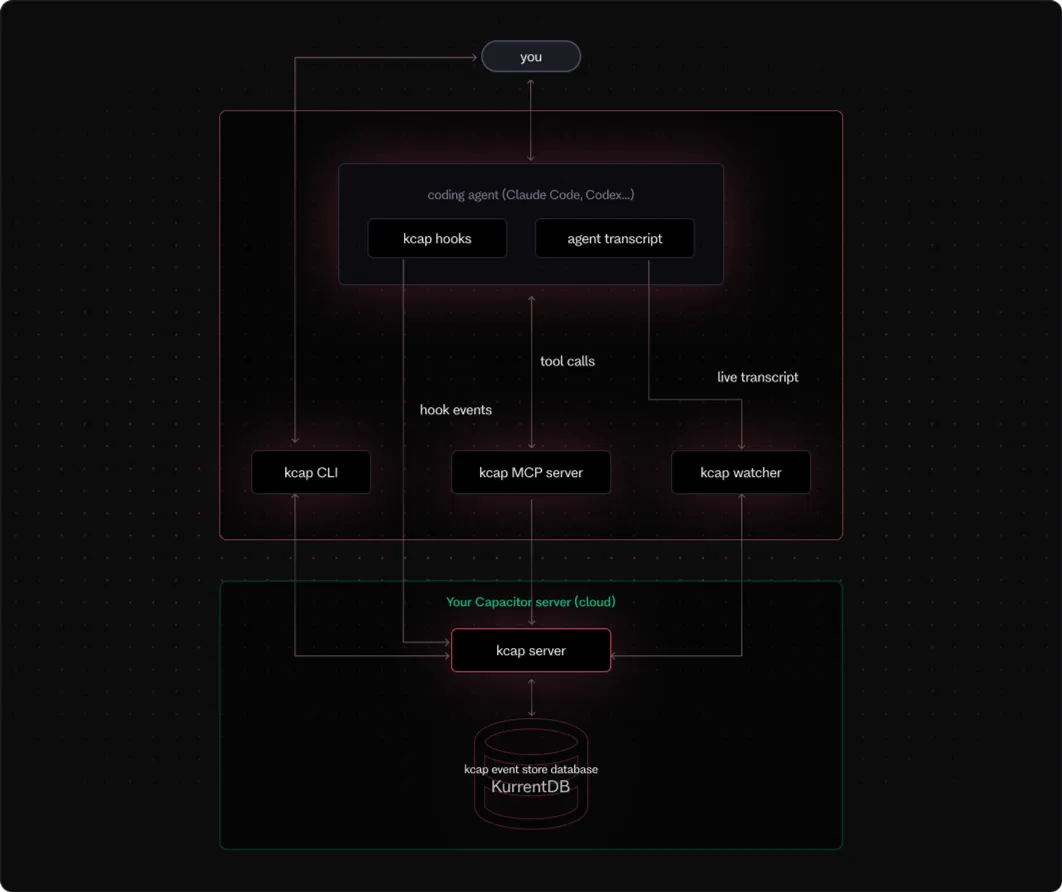
Capacitor records each coding-agent session as a durable event stream, then turns it into memory your whole team can draw on. Here’s the machinery: what runs on your machine, what runs on your server, and how one session travels between them.
On your machine
The Capacitor client is source-available — you can read every line. It installs hooks into the coding agents you choose, and a background watcher tails each agent’s own transcript file and streams it to your server as the session runs — without changing how you work.
Your capacitor server (Cloud)
A Kurrent-hosted cloud instance, dedicated to your organization. It receives the session transcript, stores each session, and builds the data models behind the dashboard and search — then answers your agents’ queries against them.
For what a recording contains, where it goes, and who can see it, see Security. For the exhaustive, field-by-field list — and the exclusions and controls in full — read What Capacitor captures, System architecture, and Visibility & sharing.