
Payments Reliability Is Not a Database Problem. It's a Data Architecture Problem Part 1

Payments Reliability Is Not a Database Problem. It’s a Data Architecture Problem.
Key Takeaways — The Short Version
- Payments reliability is rarely a database problem - Most outages, audit gaps, and fraud blind spots come from how data is modeled — not from database performance.
- Payments are sequences of events, not single records - A transaction represents a chain of authorizations, risk decisions, and state changes over time.
- Fraud detection depends on historical context - Velocity checks, behavioral baselines, and chargeback patterns require access to event history — not just current state.
- Compliance requires reconstructable history - Regulators ask what the system knew at a specific moment in time. That requires event history, not just current-state tables.
- Replay unlocks capabilities traditional systems cannot provide - Event-native architectures allow historical transactions to be reprocessed through new fraud models, compliance rules, and analytics.
- You don’t have to rip anything out - Event-native systems can deploy alongside existing brokers and begin capturing history immediately from the events you’re already producing.
The Payments Infrastructure Cycle
Every few years the payments industry goes through the same cycle.
A new database appears promising to solve the hard problems of fintech infrastructure:
- stronger consistency
- global distribution
- better scaling across regions
The implication is always the same:
Your current database wasn’t built for this world — but this one is.
There’s truth in that. Many of the databases we rely on today were designed for a different era. But after building payment demos, sitting in rooms with architects and engineering leaders at financial institutions, and watching how these systems actually evolve, I’ve come to a different conclusion.
The hardest problems in payments rarely come from the database.
They come from the data architecture.
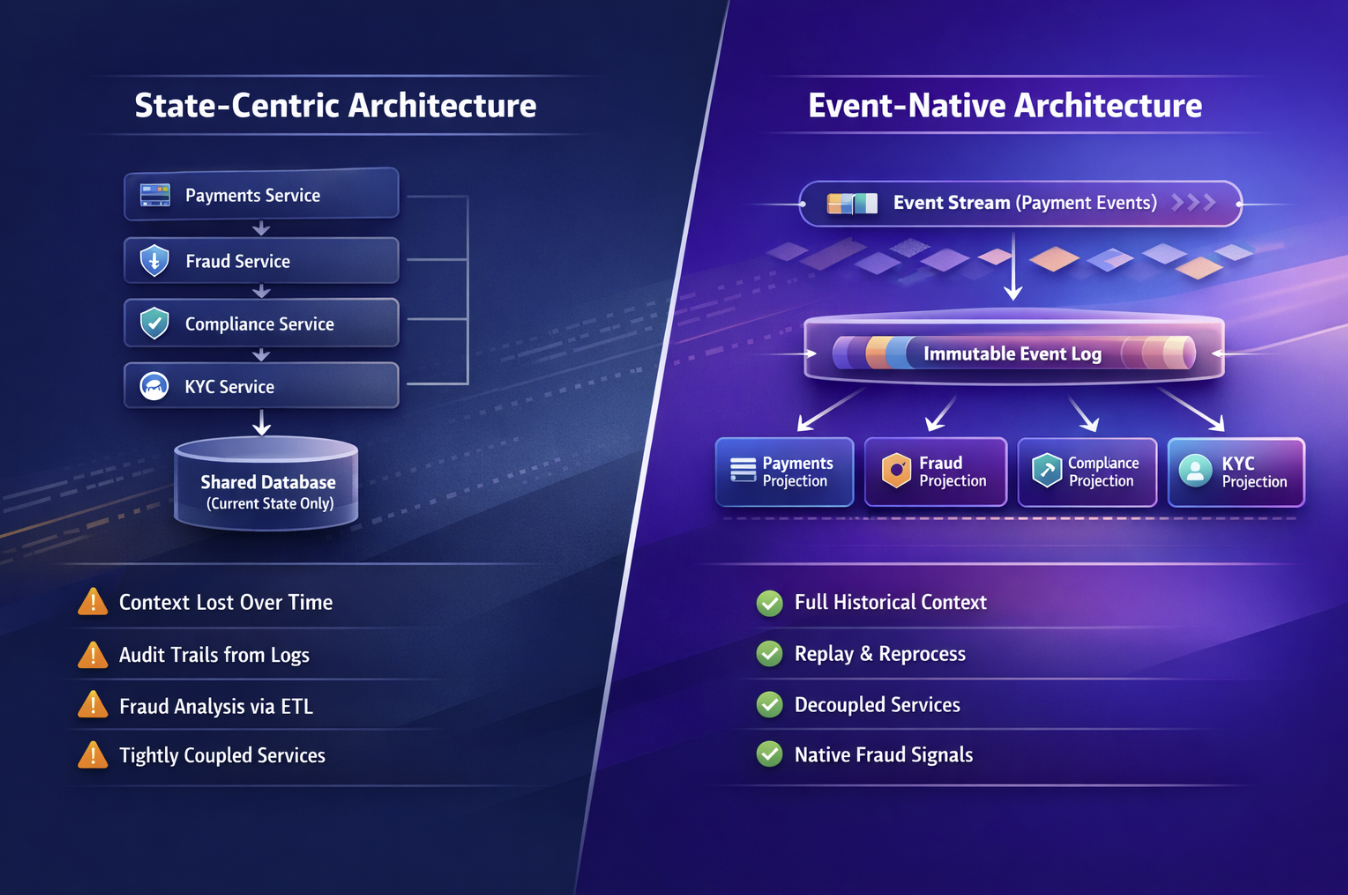
The Industry’s Default Model: Store the State
Most payment platforms are built around one simple idea:
Store what is true right now.
- Balances.
- Account status.
- Latest transaction state.
- Current risk score.
Everything revolves around the present state of the system. History — if it exists at all — usually lives somewhere else. Sometimes
- it’s in an audit table.
- it’s in logs.
- it’s archived into a warehouse through ETL pipelines.
But the operational system itself is optimized for one thing:
the current snapshot of truth. Databases have become faster, more resilient, and more globally distributed in service of this model. But the model itself hasn’t changed. And that’s where most of the problems start.
A Payment Isn’t a Record — It’s a Story
When you zoom in on a real payment, something becomes obvious.
A payment isn’t a single record.
It’s a sequence of events.
- A card is presented.
- A merchant request arrives.
- A fraud check runs.
- The issuer authorizes.
- Funds are reserved.
- Settlement is initiated.
Maybe a dispute appears weeks later.
Each step changes the state of the system.But in most architectures those changes overwrite what came before. The system only remembers the latest result.
The sequence — the reasoning — the timing — the context — is either lost or reconstructed later from logs.
Anyone who has operated a payments platform has seen the consequences:
- fraud investigations requiring log reconstruction
- compliance audits requiring point-in-time reconstruction
- dispute resolution depending on knowing what the system knew during authorization
None of these are database performance problems. They’re architectural ones.
What Engineers Told Us in Those Meetings
When we walked through this payment sequence during demos with financial institutions, the reaction was almost always the same.
Engineers would lean forward and say something like: “That’s exactly what we end up rebuilding every time there’s a dispute.” The idea of a payment being a sequence of events wasn’t new to them.
They were already living that reality — just in a much more painful way. Every investigation meant stitching together logs, traces, and database rows to recreate what happened.
Seeing that sequence modeled natively — as the system of record rather than something reconstructed afterward — was usually the moment the architecture started to click.
Fraud Detection Is a Historical Problem
Real-time fraud detection is often described as a latency challenge. Decisions must happen in milliseconds. But speed isn’t the hardest part.
Context is.
Fraud rarely reveals itself in a single transaction. It appears in patterns:
- velocity across transactions
- behavioral changes over time
- merchant relationships across accounts
- chargeback patterns across weeks or months
To evaluate a transaction in real time, the system needs to understand history instantly.
Questions like:
- What is this card’s velocity in the last 15 minutes?
- Has this merchant triggered chargebacks before?
- How does this behavior compare to the account’s baseline?
- When did this risk profile last change?
These are not queries about state. They are queries about event history.
What Landed Most in Banking Conversations
In conversations with retail banking teams, fraud context was the moment that consistently landed the hardest. Fraud teams weren’t asking for faster databases.
They were asking a simpler question:
“What did we know when we approved this transaction?”
That question sounds simple. But most architectures can’t answer it easily. They can show you the current state.But reconstructing the system state at the moment of authorization is usually a forensic exercise.
Once we framed KurrentDB as the system that makes that question answerable by default, the conversation shifted. It stopped being about infrastructure. It became about capability.
The Compliance Reality
Regulation adds another dimension.
Financial systems are expected to answer questions about the past with precision:
- What happened
- When it happened
- What the system knew at that moment
- Who authorized the decision
Distributed SQL databases are excellent at consistency across regions. But consistency does not equal auditability. If the architecture only stores current state, the audit trail becomes an afterthought.
The event history becomes the primary record. Current state becomes a projection derived from that history. Compliance questions become queries, not exercises.
What We Learned Building the Demo
When we built the compliance demo, we assumed replay would be the hardest part.
It wasn’t. The harder problem was making the audit trail queryable in the way compliance teams actually think. Compliance teams don’t think in tables or rows.They think in timelines. They ask questions like:
“Show me everything that happened to this account between these two dates.”
In an event-native system, that’s a natural query. In a state-centric architecture, answering that question often means joining multiple tables and hoping the audit logs still exist.
The Demo Moment That Changed the Room
One moment in the payments demo consistently changed the tone of the conversation.The scenario involved a fictional merchant we used called Blue Ridge Outfitters.We showed how a fraudulent transaction slipped through under the original fraud rules.
Then we rewound the event stream to the moment before authorization and replayed the transaction using updated fraud logic. The system produced the verdict that should have happened.
In several meetings the room went quiet. One architect at a regional bank said something that stuck with me:
“We have a team of three people whose entire job is doing that manually.” Replay wasn’t impressive because it was technically clever. It was impressive because it solved a problem teams had accepted as unavoidable.
The Microservices Angle
Modern fintech platforms are built from many services:
- payments
- fraud detection
- risk scoring
- KYC
- Settlement
- disputes
In many architectures these services still share databases or tightly coupled APIs. Which means they’re not truly independent. Event-native systems solve this structurally.
Services communicate through events. Each service builds its own read model from the events it cares about.
A fraud service maintains velocity metrics. A compliance service reconstructs account histories. A dispute service can replay transactions.
All without modifying the payment service.
Do We Have to Rip Everything Out?
This is usually the first practical question that comes up once people understand the model.
Financial institutions don’t replace infrastructure casually. Core systems run for years. Payment processors connect to dozens of downstream systems. Any proposal that sounds like a full architectural reset tends to stop the conversation immediately.
The good news is that an event-native approach doesn’t require ripping out what already works. Most modern payment systems are already generating events — whether through service calls, integration layers, or messaging infrastructure. Those events describe the lifecycle of a payment as it moves through authorization, risk checks, settlement, and downstream processing.
An event-native system simply captures that stream as the system of record.
Your existing producers don’t need to change. Your downstream consumers can continue operating exactly as they do today.
What changes is that the events themselves are preserved as a durable history rather than being treated as transient messages.
Once that history exists, new capabilities appear almost immediately:
- Replay becomes possible.
- Point-in-time reconstruction becomes straightforward.
- Historical projections can be built without touching the operational services.
Instead of replacing systems, you’re adding a historical foundation underneath them.
And for financial systems — where understanding what happened is often just as important as what is happening right now — that foundation turns out to be incredibly powerful.
The Real Question Fintech Should Be Asking
The conversation in payments infrastructure often focuses on which database scales best.
That’s the wrong starting point.
The more important question is:
- What does your architecture make possible five years from now?
- Can you reconstruct history easily?
- Can you replay transactions through new logic?
- Can you train fraud models on operational data?
- Can services evolve independently?
- Can you train models in real time?
These capabilities come from how the system treats history. Event-native architectures start from a simple principle:
Event is the source of truth and the primary record. State is derived.
In financial services — where understanding what happened often matters more than what is happening right now — that difference becomes critical.
Because once history is gone, no database can bring it back.
Coming Up in This Series
Part 2
AI in Financial Services Runs on Events
About Kurrent
Kurrent builds KurrentDB, an event-native database designed for financial services and other systems where history, traceability, and replay are first-class requirements.
